
Ray Nano Science & Research Centre continues to demonstrate the agronomic effectiveness of nano-enabled phosphorus fertilizers under demanding agro-ecological conditions.
A recent field observation conducted in Cotabambas, Apurímac (Andean region) at an altitude of approximately 3,800 meters above sea level highlights the remarkable crop response achieved with RayGro Nano DAP in potato cultivation.
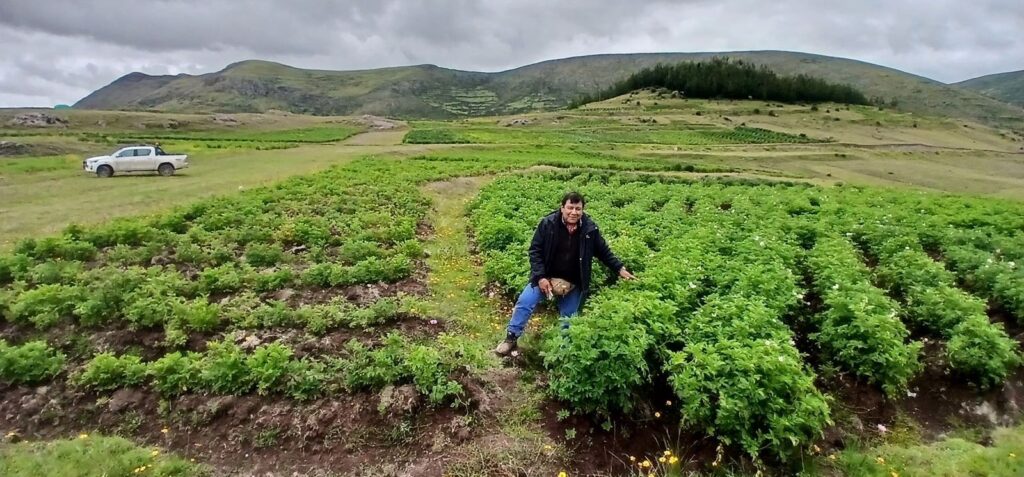
The field provided a clear side-by-side comparison:
- Right side: Crop treated with RayGro Nano DAP
- Left side: Conventional fertilization Practices
The treated section shows substantially higher canopy density, stronger vegetative growth, and more uniform crop development, indicating improved nutrient assimilation and plant vigor compared to the conventional practices.
Scientific Interpretation of the Field Response
From a fertilizer science perspective, the observed improvement is primarily linked to enhanced phosphorus availability and utilization efficiency.
Phosphorus is a critical macronutrient responsible for:
- Tuber and reproductive development
- Root development and early plant establishment
- Energy transfer through ATP synthesis
- Cell division and metabolic activity
However, in conventional fertilization systems, phosphorus availability is often limited due to soil fixation and poor mobility. These limitations are further intensified in high-altitude agricultural systems, where:
- Soil temperatures are lower
- Microbial activity is reduced
- Nutrient diffusion in soil is slower
Under such conditions, conventional phosphorus fertilizers frequently exhibit low phosphorus use efficiency (PUE).
How RayGro Nano DAP Improves Nutrient Efficiency
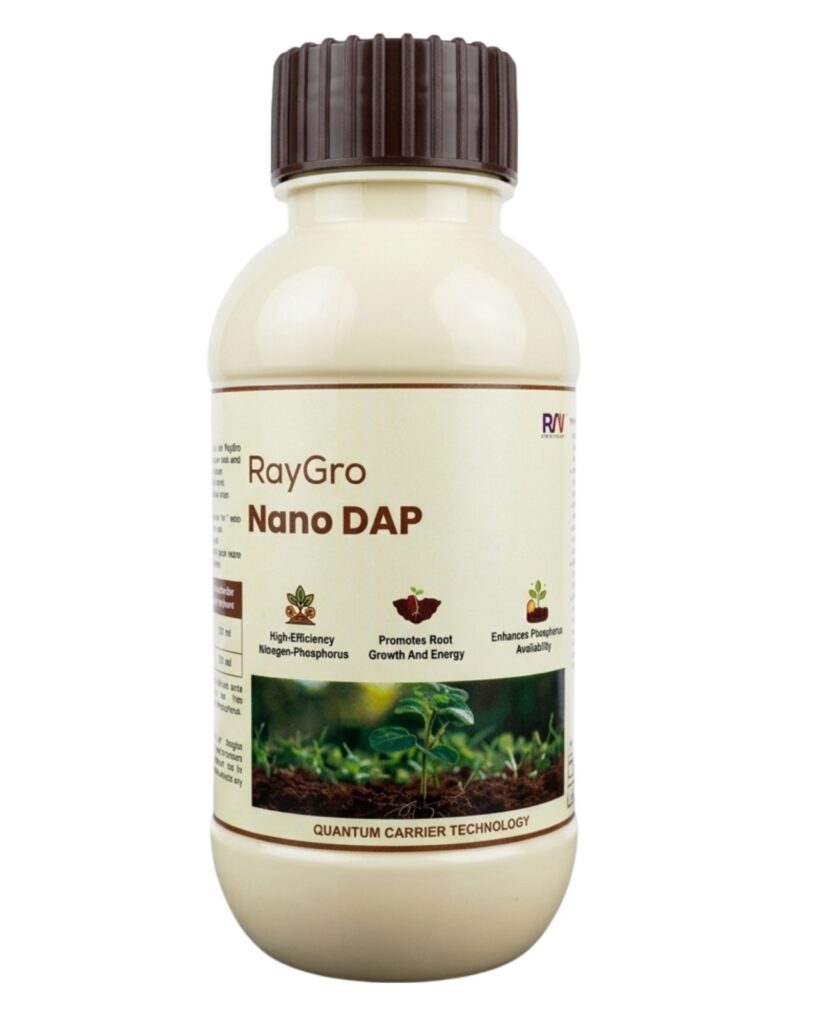
RayGro Nano DAP utilizes nano-engineered nutrient carriers designed to optimize nutrient delivery and plant uptake.
The agronomic advantages include:
- Nano-scale particles possess a significantly higher surface area, enabling faster interaction with plant tissues and improved nutrient accessibility.
- Nano nutrients can enter plant systems through stomatal pathways, epidermal absorption, and root uptake, facilitating rapid nutrient translocation within plant tissues.
- The nano-formulated phosphorus reduces the probability of nutrient immobilization in soil, improving the fraction of applied phosphorus that becomes available to crops.
- Improved phosphorus availability stimulates root proliferation, energy metabolism, and biomass formation, which explains the stronger canopy development observed in the treated crop.
Agronomic Significance of the Results
The results from this high-altitude field observation demonstrate that RayGro Nano DAP can significantly improve phosphorus efficiency even in nutrient-limited environments.
Stronger vegetative growth and canopy expansion indicate improved photosynthetic capacity and nutrient assimilation, which are directly linked to improved crop productivity potential.
Such outcomes are particularly important for regions where conventional fertilizer efficiency is limited by soil chemistry, climatic stress or altitude-related constraints.
Conclusion
The field observation from Cotabambas, Apurímac (~3,800 m elevation) provides compelling agronomic evidence of the performance advantages of RayGro Nano DAP.
The treated crop demonstrates enhanced vegetative growth, improved canopy structure, and stronger plant vigor, reflecting higher phosphorus use efficiency and improved nutrient assimilation.
These results reinforce the role of nano-enabled fertilizers as a next-generation solution for improving fertilizer efficiency and crop productivity across diverse agricultural landscape.

